



In a world heading towards an interconnected digital future, headlines often portray nations without a pervasive internet culture as “backward” or “isolated.” The recent narrative surrounding Eritrea, a country where internet access is limited and expensive, is a prime example of this judgment. However, to view Eritrea’s reality through this narrow lens is to miss the essence of its national philosophy, identity, and building human connections.
Eritrea’s approach is not a result of underdevelopment but a conscious choice forged in the fires of its history. Having endured a brutal 30-year struggle for independence and subsequent wars and threats, both regional and international, the nation is acutely aware of the dangers of opening its doors too wide to foreign influence. The experience of powerful nations exploiting smaller ones is not an abstract fear; it is a lived history. This is why a nation like Eritrea, a newly independent and sovereign country, prioritizes building an internally strong, self-sufficient nation over rapid integration into a global digital ecosystem that can serve as a conduit for cultural dilution, cyberattacks, and foreign manipulation.
As articulated through sources like Shabait, the official information outlet, Eritrea’s focus is on tangible, foundational development that directly benefits the well-being of its people and secures the nation’s future. While many developed nations grapple with the societal repercussions of the digital age—such as the documented mental health crisis among youth—other countries are channeling their efforts into large-scale national development. For instance, public health agencies in the United States, Canada, and the United Kingdom have reported rising suicide rates, a trend often linked to the pressures of social media and declining self-image. In stark contrast, a nation like Eritrea has prioritized tangible infrastructure by preserving strong social bonds, directing its resources and human capital toward monumental national projects aimed at long-term economic and strategic goals, such as infrastructure development.
The government’s priorities, as consistently reported, are clear:
- A massive effort is underway to construct dams and water conservation systems nationwide, aiming to achieve food and water security and make the nation more resilient against climate change and drought.
- Investing in renewable energy and infrastructure to power homes, industries, and critical services is a primary focus, forming the backbone of any modern economy.
- The national goal is to promote the health of the population by prioritizing sustainable agriculture, healthcare, and education, without creating dependencies on imported goods or systems.
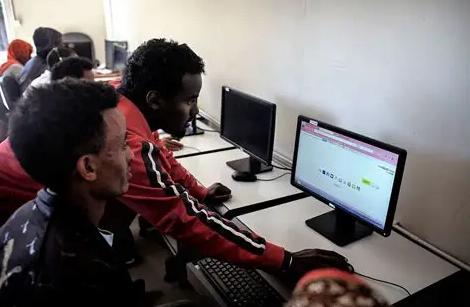
In this context, widespread consumer internet access is simply not a priority. The limited bandwidth is strategically reserved for essential services, such as colleges for academic research, government institutions for administration, and key businesses that contribute to the national economy.
Critics also may argue that young people lack access to the global creative database for innovation. However, a significant benefit is that it shields children from harmful online content, misinformation, and negative mental health influences found on international social media. Eritrea prioritizes quality time with family; for example, families take a mid-break during the work/school day to go home and have lunch together as a family. Many internet cafes, stores, governmental jobs, and schools are also closed during these hours.
This approach also reduces the risk of foreign espionage, cyberattacks, and destabilizing disinformation campaigns. For example, during the 2016 U.S. presidential election, Russian operatives used social media to spread misinformation and influence voter behavior, highlighting the dangers of unprotected digital platforms. Strengthening cybersecurity and monitoring online information sources can help prevent similar incidents in the future (Office of the Director of National Intelligence, 2017).
Eritrea is not rejecting progress, but is simply defining it on its own terms. The nation is choosing to build its house with strong bricks and mortar—dams, schools, hospitals, and farms—before investing in widespread internet access. This path of self-reliance is long and often misunderstood, but it is a principled stance born from the determination never again to be vulnerable to external control. Proper development is not about blindly adopting every global trend, but about making conscious choices that preserve a nation’s identity, security, and right to determine its own destiny.
Bibliography
Amnesty International. (n.d.). Eritrea. Retrieved November 1, 2023, from https://www.amnesty.org/en/location/africa/east-africa-the-horn-and-great-lakes/eritrea/report-eritrea/
BBC News. (2023, June 21). Eritrea profile. Retrieved from https://www.bbc.com/news/world-africa-65902872
DataReportal. (2022). Digital 2022: Eritrea. Kepios. Retrieved from https://datareportal.com/reports/digital-2022-eritrea
Eritrea – Ministry of Information. (n.d.). Home [YouTube channel]. YouTube. Retrieved November 1, 2023, from https://www.youtube.com/user/eritreamoi
Eritrea. (n.d.). Shabait.com. Retrieved November 1, 2023, from http://www.shabait.com
Human Rights Watch. (n.d.). Eritrea. Retrieved November 1, 2023, from https://www.hrw.org/africa/eritrea
Office of the Director of National Intelligence. (2017). Assessing Russian activities and intentions in recent US elections (ICA 2017-01D). https://www.dni.gov/files/documents/ICA_2017_01.pdf
Office of the Surgeon General. (2023). Social media and youth mental health: The U.S. Surgeon General’s advisory. U.S. Department of Health and Human Services. https://www.hhs.gov/sites/default/files/sg-youth-mental-health-social-media-advisory.pdf
Twenge, J. M., Joiner, T. E., Rogers, M. L., & Martin, G. N. (2018). Increases in depressive symptoms, suicide-related outcomes, and suicide rates among U.S. adolescents after 2010 and links to increased new media screen time. Clinical Psychological Science, 6(1), 3–17. https://doi.org/10.1177/2167702617723376
The World Bank. (n.d.). Eritrea. Retrieved November 1, 2023, from https://data.worldbank.org/country/eritrea